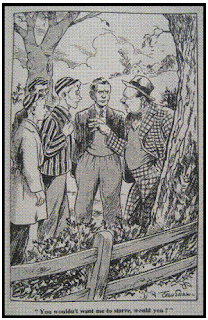
In the 50’s and 60’s Ern Shaw drew for the Dalesman magazine and these are examples of his work.


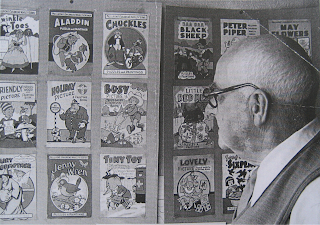
Some of the most famous names in publishing published his books, such as Mellifont Press who published one series of 100 books which Ern Shaw created and illustrated.
Other publishers who published his books were Hutchinson and Collins.


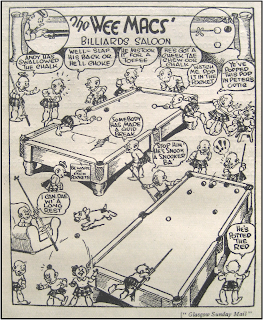
 Tiny, Mac,Toodles, Mick and Twanky and many more, were names for the funny colourful pixie like characters that Ern Shaw created called the ‘Dingbats’. These characters appeared in annuals, colouring books and games.


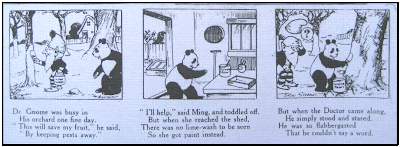
 Another serial strip cartoon drawn by Ern Shaw was Dr. Gnome of Gnomesland. The adventures of Dr. Gnome and the panda Miss Ming ran in the ‘Woman’s Illustrated’ magazine for over 21 years. The character Miss Ming was based on a real panda called Ming brought over from China to be bred at London Zoo and in 1940 was adopted by the Woman’s Illustrated’ to help pay for her upkeep. Ern Shaw thought that such a lovable animal would be a nice friend for Dr. Gnome so he introduced the character into the strip and they had lots of adventures together.


A postcard drawn by Ern Shaw of the clubs new home, Craven Park, 1922
For a brief period they were known as Kingston Rovers before becoming Hull Kingston Rovers by 1885. The traditional colours of the club are white shirts with a red band. Hull KR's nickname is 'The Robins' which comes from their playing colours.
Hull Kingston Rovers Rugby League Team were delighted when Ern Shaw produced a cartoon, showing each member of the team entitled “Hull KR’s Record Season,” acknowledging their record season in 1966/67.
 Hull FC
Hull FC is one of the oldest clubs in the League and was formed by a group of ex-public schoolboys from York in 1865. They joined the breakaway from the English Rugby Union in 1896, which led to the new game of Rugby League. The club's first ground was at Woodgates Hall, North Ferriby. In 1895, the club moved to the Hull Athletic Club's ground at the Boulevard, Airlie Street, which gave rise to their nickname "The Airlie Birds". The club now plays at the new Kingston Communications Stadium, (KC Stadium) on the site of the former cricket club which it shares with Hull City Football Club (Tigers). The traditional colours of the club shirts are black and white and they are often called the ‘Black and Whites’
 A Hull FC cartoon, 1964 by Ern Shaw

 Ern Shaw’s first exhibition was held with Harry H. Rodmell the marine artist from Hull in 1929 at the City Hall Art Gallery in Hull. Rodmell was a friend of Ern Shaw's and he mainly concentrated on marine subjects such as: posters for shipping companies, booklets, etchings, and line drawings of ships.
 Ern Shaw did not have the advantages of modern drawing technology but his drawings were produced using various grades of pens and brushes and his drawings were works of art in their own right. His style varied depending on the subject of his work but his use of bold clear strokes of his pen and use of bright colours was his hall mark.His first successful drawing published at the age of 12, was a result of him winning a competition organised by the Hull Times. His sketch of a building known as “Plum Pudding Hall” brought him five shillings and set Ern Shaw off on his amazingly productive career which spanned over 70 years.

 When he left school, Ern Shaw worked for a draper for seven years and during this period he took a correspondence course in drawing, organized by the Press Art School, London, run by the founder and principal Percy V. Bradshaw. Percy V. Bradshaw was a well known artist, author and artists agent. In many cases, he spoke for the world of commercial art.
 Today Wacom has established itself as the leader in the world market for pen tablets and pioneers in the development of the pen as a computer input device. Since the early days in the 1980’s Wacom has continued to develop a wide range of powerful graphics programmes. Today graphics professionals can produce conventional drawings on the computer using the tablets drawing and writing tools – from the paintbrush to the pen and pencil, crayon to charcoal and image editing tools.


