Tuesday, April 28, 2009

Ern Shaw and Sport

The following is a quote from Ern Shaw’s book on how to become a sporting cartoonist:
“Sport offers a wonderful opportunity to the cartoonist, but to be successful, a highly developed sense of observation, ability and imagination are essential. No artist can hope to make a success of sports cartooning until he has learned to draw the human figure in action."
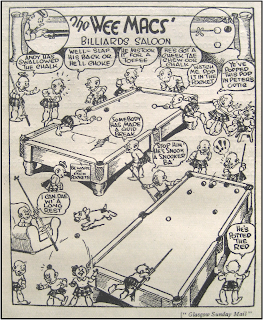
"I began by visiting a billiards hall and watching the players in their various poses. This being a slower game than, say football or boxing; I had the time to register a pose and make quick notes in my sketch book.
Once you have become proficient in drawing the human figure in action and posses, and the ability to make recognizable caricatures of sporting personalities, you will at least have laid the foundation to become a sports cartoonist.

The camera can record incidents, like the shooting of a goal or a brilliant save but the cartoonist can observe such incidents from the press box or stand, and perhaps give them a more humorous “twist” and produce a pictorial version which would prove very entertaining to newspaper readers.”

Thursday, April 9, 2009

Ern Shaw and Hull City Football Club (also known as the Tigers)

The club was founded in Hull 1904 and played for the first three years at the Boulevard Rugby League ground. They eventually moved to the ground of Hull Cricket Club before moving to Boothferry Park.
Ern Shaw would pop into the Press-box among the sports writers for the home games at Boothferry Park and sit unobtrusively at the back of the box, turning out his cartoon masterpieces with consummate ease and the minimum of fuss.
Ern Shaw had a long association with the club and his earliest cartoons of two rather cuddly tigers in bow ties adorned the cover of the club’s match programme from 1913 to 1927.


He produced cartoons for the club’s programme and his cartoons also appeared in the ‘Tiger Mag’, a postwar magazine for the city fans. The ‘Tiger Mag’ was popular because it coincided with one of the most successful times in the club’s history-when they gained promotion as Third Division North Champions under Raich Carter’s management in 1948-49.


The club now plays their games at the 25,000 capacity Kingston Communications Stadium which they moved to in 2002 on the site of the former Cricket Club.
They traditionally play in black and amber, often with a striped shirt design, hence their nickname the ‘Tigers’
After a successful 2007/ 2008 season, they were promoted to the Premier League for the first time in their history via a 1-0 playoff win over Bristol City with a Dean Windass winning volley, under the management of Phil Brown and chairmanship of Paul Duffen.

Friday, March 20, 2009

Ern Shaw's Rugby League Cartoons

Ern Shaw was inspired by the cartoonist, Tom Webster (1886 -1962), a British cartoonist and caricaturist who specialised in sporting cartoons. Ern Shaw was later to be considered Humberside’s “Tom Webster,” particularly on the soccer and rugby league scenes. He delighted the people of Hull by drawing cartoons of matches played by Hull KR and Hull FC and many of the great players felt they had not ‘arrived' until Ern Shaw had drawn a cartoon of them which was then published in the local paper.

Hull KR
Hull Kingston Rovers were formed in 1882 by a group of boilermakers and started life as Kingston Amateurs playing in Albert Street to the west of the city in the autumn of 1883.
They played on several grounds on the west of the river including a spell at the Boulevard, which later became the home of their rivals Hull FC. Rovers then moved to the East of Hull, Craven Park, which is there ground today.


A postcard drawn by Ern Shaw of the clubs new home, Craven Park, 1922

For a brief period they were known as Kingston Rovers before becoming Hull Kingston Rovers by 1885. The traditional colours of the club are white shirts with a red band. Hull KR's nickname is 'The Robins' which comes from their playing colours.

Hull Kingston Rovers Rugby League Team were delighted when Ern Shaw produced a cartoon, showing each member of the team entitled “Hull KR’s Record Season,” acknowledging their record season in 1966/67.

Hull FC
Hull FC is one of the oldest clubs in the League and was formed by a group of ex-public schoolboys from York in 1865. They joined the breakaway from the English Rugby Union in 1896, which led to the new game of Rugby League. The club's first ground was at Woodgates Hall, North Ferriby. In 1895, the club moved to the Hull Athletic Club's ground at the Boulevard, Airlie Street, which gave rise to their nickname "The Airlie Birds". The club now plays at the new Kingston Communications Stadium, (KC Stadium) on the site of the former cricket club which it shares with Hull City Football Club (Tigers). The traditional colours of the club shirts are black and white and they are often called the ‘Black and Whites’

A Hull FC cartoon, 1964 by Ern Shaw

Newspaper cartoons


Ern Shaw in the 1920's produced political cartoons for the 'Hull Evening News'

Friday, March 13, 2009

Ern Shaw's first exhibition

Ern Shaw’s first exhibition was held with Harry H. Rodmell the marine artist from Hull in 1929 at the City Hall Art Gallery in Hull. Rodmell was a friend of Ern Shaw's and he mainly concentrated on marine subjects such as: posters for shipping companies, booklets, etchings, and line drawings of ships.


The title of the exhibition was 'Exhibition of Ships and Humour'.
The exhibition included a selection of Ern Shaw's cartoons and illustrations and Harry Rodmell's posters and sketches. The black and white brochure produced for the exhibition consisted of caricatures of Ern Shaw and Harry Rodmell.

Tuesday, March 10, 2009

Ern Shaw's early work

Ern Shaw did not have the advantages of modern drawing technology but his drawings were produced using various grades of pens and brushes and his drawings were works of art in their own right. His style varied depending on the subject of his work but his use of bold clear strokes of his pen and use of bright colours was his hall mark.His first successful drawing published at the age of 12, was a result of him winning a competition organised by the Hull Times. His sketch of a building known as “Plum Pudding Hall” brought him five shillings and set Ern Shaw off on his amazingly productive career which spanned over 70 years.

At the end of the first world war Ern Shaw illustrated the book 'Good bye-ee' by Arthur Seymour depicting the humorous side of demobilisation.


Percy Bradshaw's comments about Ern Shaw

Percy V. Bradshaw thought very highly of Ern Shaw and in 1946 wrote the foreword in Ern Shaw's book, 'How to become a successful Cartoonist'. He said of the cartoonist that, 'I'm delighted to have the opportunity of introducing Ern Shaw to you, and of giving my blessing to this little book. For Ern Shaw was one of my first pupils and I have watched with growing amazement the inexhaustible range of work and the irrepressible enthusiasm of this Boy Who Wouldn't Grow Up. I am always staggered at the variety and quality of work which he displays. The first thing you will notice about Ern Shaw's drawings is the straight forward simplicity of his style. I wish that the pages in this book could have been reproduced in colour, for his fresh, bold colour is certainly one of Ern Shaw's very strong points'.'His comic people and animals can be seen in Children's books, card games, strip cartoons, sports cartoons and many more publications. The plump figures engaged in such cheerful adventures are very characteristic of Ern Shaw himself. I shall always be comforted to remember that I was privileged to help him when he was younger'.